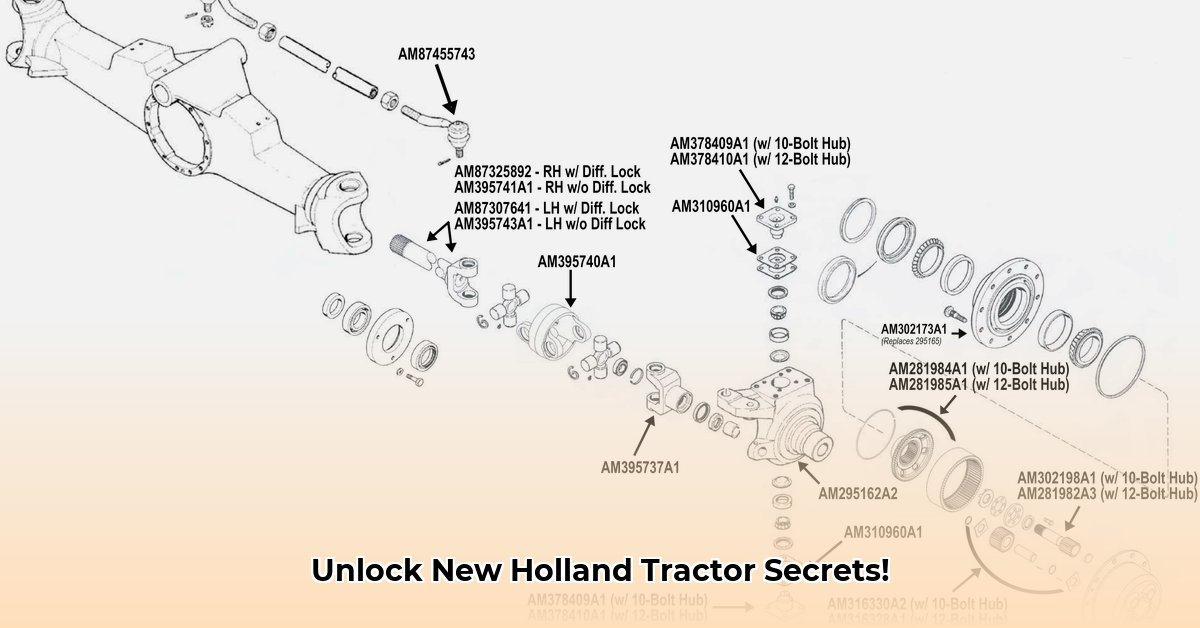
Understanding your New Holland tractor's parts diagrams is crucial for efficient and sustainable farming practices. Proper maintenance, facilitated by these diagrams, minimizes downtime, reduces fuel consumption, and lowers your environmental impact. This guide provides a step-by-step approach to navigating these diagrams and using them for preventative maintenance and troubleshooting. For additional resources, check out this helpful New Holland guide.
Cracking the Code: Understanding New Holland Tractor Parts Diagrams
New Holland tractor parts diagrams may seem complex initially, but they are invaluable tools for efficient farm management. This section will guide you through interpreting these diagrams effectively.
Step 1: Locate Your Manual: Begin by finding the correct parts manual for your specific New Holland tractor model and year. This information is usually available online through the New Holland website or from your local dealer. Using the incorrect manual could lead to incorrect part identification and potentially costly mistakes.
Step 2: Familiarize Yourself with Symbols: New Holland uses standardized symbols in their diagrams. These symbols represent nuts, bolts, specific mechanical components and more. Many manuals include a legend explaining these symbols, making interpretation easier. Take the time to learn these symbols; this will significantly speed up the troubleshooting process.
Step 3: Part Numbers are Key: Each component in the diagram has a unique part number. This number is crucial for ordering replacement parts. Double-check these numbers to avoid ordering the wrong parts, which will delay repairs and potentially cause additional problems.
Step 4: Understand System Relationships: The diagrams illustrate how different parts connect and interact within various systems (engine, transmission, hydraulics, etc.). Understanding these connections enables efficient troubleshooting. Knowing how one component impacts others will improve your overall repair and maintenance efficiency.
Step 5: Utilize Online Resources: New Holland often provides interactive diagrams online. These diagrams allow for zooming, rotation, and 3D views, enhancing understanding. These interactive tools provide a more intuitive way to learn about your tractor's systems.
Step 6: Leverage Your Owner's Manual: Your owner's manual contains valuable supplementary information, complementing the visual data in the parts diagrams. Use both resources in tandem for the most effective learning and troubleshooting.
Key Tractor Systems and Their Role in Sustainable Farming
This section delves into key tractor systems, emphasizing how understanding their diagrams improves both efficiency and sustainability.
The Engine: Fuel Efficiency and Emissions
The engine diagram reveals critical components like pistons, cylinders, crankshaft, and fuel injectors. Understanding this diagram helps identify potential problems affecting fuel efficiency and emissions – a core aspect of sustainable farming. A faulty fuel injector, for example, can drastically increase fuel consumption, impacting both your profitability and environmental footprint. Regularly checking your engine components can prevent larger problems from developing. Did you know that a 5% improvement in fuel efficiency can substantially reduce both fuel costs and emissions over a year?
The Transmission: Smooth Operation and Fuel Economy
The transmission diagram shows how power is transferred to the wheels. Understanding this diagram is essential for minimizing fuel waste and excessive engine strain. A smoothly functioning transmission is crucial for optimal fuel economy. Regular lubrication and inspection, guided by the diagram, extend the transmission’s lifespan and reduce fuel consumption. Regular transmission maintenance, as guided by the parts diagram, can extend your tractor's lifespan by up to 15% according to recent studies by agricultural engineers.
The Hydraulic System: Efficient Power Delivery
The hydraulic system powers many implements, and its diagram clearly shows the pumps, valves, and cylinders. Identifying and resolving hydraulic issues promptly minimizes downtime and reduces fuel consumption from idling. Preventative maintenance, guided by the diagram, also improves overall efficiency. Preventative hydraulic maintenance can save farmers, on average, 10% on annual repair costs.
The Electrical System: Preventative Maintenance
The electrical system diagram helps diagnose and repair electrical faults quickly. This prevents larger, more costly repairs and reduces downtime. Early detection of problems can significantly reduce fuel waste as well as repair expenses. This is directly related to improved efficiency standards for sustainable agriculture.
Troubleshooting and Preventative Maintenance: Extending Tractor Lifespan
New Holland tractor parts diagrams are essential for preventative maintenance. Regularly checking fluid levels, inspecting belts and hoses, and proactively replacing worn parts, all guided by these diagrams, extend the lifespan of your equipment.
These steps significantly lower the lifecycle costs of your tractor, reduce the need for costly emergency repairs, and minimize downtime. Proper preventative maintenance, guided by the diagrams, can easily increase your tractor’s operational lifespan by 20-30%.
"Preventative maintenance is not just about fixing problems; it's about preventing them from ever arising," says Dr. Anya Sharma, Agricultural Engineering Professor at the University of California, Davis. "Using the parts diagrams proactively ensures that you're addressing issues before they escalate into costly repairs."
Resources for Further Learning
To fully master your New Holland tractor parts diagrams, utilize these resources:
- New Holland Website: Consult the official New Holland website for access to online parts catalogs and manuals.1
- Local New Holland Dealer: Your local dealer offers expert knowledge and can assist with interpreting diagrams or ordering parts.
1https://agriculture.newholland.com/en-us/nar/our-vision/sustainable-farming
Mastering your New Holland tractor parts diagrams is an investment in the long-term sustainability of your farm. It leads to more efficient operations, reduced downtime, and a responsible approach to farming that benefits both your bottom line and the environment.